
Cat litter is an essential pet-care product used by millions of cat owners around the world. As demand for convenient, absorbent, low-dust, and environmentally friendly litter continues to grow, manufacturers are developing different types of products based on mineral, wood, soybean, corn, paper, and other plant-based materials.
Although cat litter may look like a simple granular product, commercial manufacturing involves a series of carefully controlled processes. The exact production method depends on the type of litter being manufactured. Bentonite litter, tofu litter, wood litter, and other plant-based products have different raw material and processing requirements.
A modern cat litter factory can integrate raw material preparation, crushing, grinding, mixing, granulation or pelletizing, drying, cooling, screening, coating, dust collection, and packaging into a complete production system. The objective is to produce litter with consistent particle size, suitable absorption, good odor control, low dust, and stable physical properties.
This article explains the complete cat litter manufacturing process, from raw material selection to finished product packaging, and discusses the equipment, quality-control measures, and production considerations involved in building a commercial cat litter factory.
1. What Is Cat Litter Made From?
The first step in understanding the manufacturing process is identifying the raw materials.
Different types of cat litter use different materials.
Common raw materials include:
- Bentonite clay
- Wood
- Sawdust
- Soybean residue
- Corn
- Cassava
- Grass fiber
- Paper
- Bamboo fiber
- Coconut fiber
- Agricultural residues
- Silica-based materials
The choice of raw material determines the basic characteristics of the finished product.
For example, bentonite is well known for its clumping and swelling properties, while wood and soybean residue are commonly used for plant-based products.
2. Different Types of Cat Litter
Before designing a production line, manufacturers should determine which type of cat litter they intend to produce.
Bentonite Cat Litter
Made primarily from bentonite clay and widely used for clumping litter.
Tofu Cat Litter
Usually made from soybean residue, soybean fiber, and other plant-based ingredients.
Wood Cat Litter
Produced from sawdust, wood shavings, wood fiber, or suitable wood-processing residues.
Corn Cat Litter
Made from corn-based materials or agricultural by-products.
Paper Cat Litter
Produced from processed paper or recycled paper materials.
Silica Gel Cat Litter
Made from silica-based absorbent materials and manufactured through a different industrial process.
Because each category has different characteristics, there is no universal cat litter manufacturing process.
3. Step 1: Select Suitable Raw Materials
Raw material selection is the foundation of cat litter production.
Manufacturers should consider:
- Absorption
- Moisture
- Particle size
- Purity
- Density
- Pelletizing characteristics
- Odor
- Availability
- Cost
For plant-based cat litter, raw materials should be clean and free from unsuitable contaminants.
For wood litter, manufacturers should avoid painted, chemically treated, or contaminated wood.
For soybean-based products, fresh soybean residue should be handled appropriately because it can contain substantial moisture.
For bentonite products, mineral composition and swelling characteristics should be tested.
4. Step 2: Raw Material Receiving and Storage
After sourcing, raw materials are delivered to the factory.
A commercial plant may use:
- Receiving hoppers
- Conveyors
- Storage bins
- Silos
- Feeding systems
Proper storage is particularly important for moisture-sensitive materials.
Plant-based materials should generally be protected from excessive humidity, rain, and contamination.
Bentonite should also be protected from moisture because it can absorb water during storage.
Stable storage conditions help maintain consistent production.
5. Step 3: Cleaning the Raw Materials
Raw materials may contain unwanted materials.
A cleaning system can remove:
- Stones
- Metal
- Plastic
- Soil
- Oversized foreign materials
- Other contaminants
Depending on the raw material, equipment may include:
- Vibrating screens
- Magnetic separators
- Cleaning screens
- Manual inspection systems
Cleaning improves product quality while protecting downstream equipment.
6. Step 4: Crushing
Large raw materials need to be reduced in size before grinding or granulation.
This is particularly important for:
- Wood chips
- Straw
- Corn stalks
- Bamboo
- Agricultural residues
- Large mineral pieces
A crusher reduces large materials into smaller particles.
Sawdust and other already-fine materials may require little or no crushing.
The equipment should therefore be selected according to the actual raw material.
7. Step 5: Grinding
Grinding is commonly used to prepare raw materials for pelletizing or granulation.
A hammer mill or other suitable grinding equipment can reduce the material to the required particle size.
Particle size affects:
- Pellet formation
- Pellet strength
- Absorption
- Surface quality
- Dust generation
- Drying efficiency
The material should not necessarily be ground into extremely fine powder.
Instead, the target particle size should be determined through production testing.
8. Step 6: Drying
Moisture control is one of the most important parts of the manufacturing process.
Plant-based materials such as soybean residue, grass, and wood may contain significant amounts of moisture.
A dryer can reduce moisture to a suitable level.
Industrial production may use:
- Rotary dryers
- Drum dryers
- Air-flow drying systems
- Other suitable drying technologies
The drying process depends on:
- Initial moisture
- Required final moisture
- Material type
- Production capacity
- Heat source
Efficient drying is essential because excessive moisture can increase energy consumption and cause production problems.
9. Step 7: Batching and Formulation
Some cat litter products use multiple raw materials.
For example, a plant-based formula may contain:
- Soybean residue
- Corn starch
- Plant fiber
- Odor-control materials
- Activated carbon
The materials should be accurately measured according to the formula.
An automated batching system can improve formulation accuracy.
This is particularly important for large commercial plants producing consistent products across multiple production batches.
10. Step 8: Mixing
After batching, the ingredients are mixed.
A horizontal mixer or other suitable industrial mixer can be used.
The goal is to distribute all ingredients evenly.
Uniform mixing ensures that every batch has consistent:
- Absorption
- Density
- Pellet strength
- Odor-control characteristics
- Appearance
Poor mixing can result in uneven product quality.
11. Step 9: Moisture Adjustment
Before pelletizing or granulation, the material may require additional moisture adjustment.
Water can be added through a controlled spraying system.
The ideal moisture level depends on:
- Raw material
- Particle size
- Binder content
- Pellet mill
- Granulator
- Desired product density
Too much moisture can create weak or unstable pellets and increase drying requirements.
Too little moisture can make pellet formation difficult.
Therefore, moisture should be monitored carefully.
12. Step 10: Pelletizing or Granulation
This is the stage where loose raw materials are transformed into usable cat litter particles.
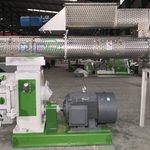
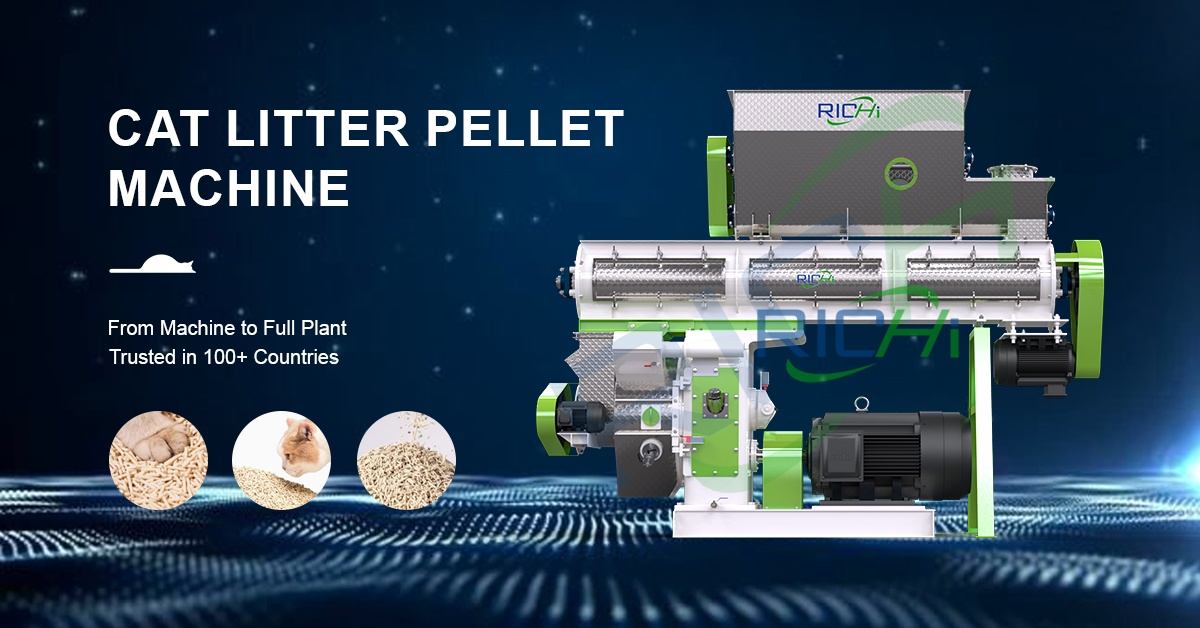
Plant-based cat litter is often pelletized using a pellet mill.
Inside the pellet mill, rollers compress the material through a die.
The material exits as cylindrical pellets.
Other products may use granulators to create rounded or irregular particles.
Bentonite cat litter may use a different granulation process designed specifically for mineral materials.
The equipment should be selected according to the product type.
https://pelletisingmachine.com/cat-litter-pellet-machine
13. How Pellet Size Is Controlled
Particle size is important for cat litter performance and consumer preferences.
Manufacturers can control size through:
- Die-hole diameter
- Cutter adjustment
- Granulator settings
- Screening
Different products may use different particle sizes.
Fine particles may provide a softer texture, while larger pellets can reduce tracking and dust.
The ideal size depends on the product positioning and target market.
14. Step 11: Drying the Fresh Pellets
Freshly formed plant-based pellets may contain excess moisture.
A second drying stage may therefore be required.
The dryer reduces moisture and improves storage stability.
Important parameters include:
- Air temperature
- Material residence time
- Airflow
- Feed rate
- Final moisture
Drying should be carefully controlled to avoid unnecessary energy consumption or excessive heat exposure.
15. Step 12: Cooling
After drying, the product is cooled.
Fresh pellets may still be warm after leaving the dryer.
A cooling machine helps:
- Reduce product temperature
- Stabilize pellets
- Prevent condensation
- Prepare the material for screening
- Improve packaging conditions
Cooling is particularly useful for continuous commercial production.
16. Step 13: Screening
The cooled product enters a screening system.
The screen separates:
- Finished particles
- Fine powder
- Broken pellets
- Oversized particles
A vibrating screen or rotary screen can be used.
The correctly sized litter proceeds to the next stage.
Suitable fines may be returned to production to reduce material waste.
17. Why Screening Is Important
Screening has a major impact on finished product quality.
Without proper screening, the product may contain excessive:
- Dust
- Fine particles
- Oversized granules
- Broken pellets
A consistent particle-size distribution improves:
- Appearance
- Absorption consistency
- Packaging
- Consumer experience
Screening also helps manufacturers produce different grades from the same production system.
18. Step 14: Odor-Control Treatment
Odor control is one of the most important performance characteristics of cat litter.
Depending on the formula, manufacturers may add:
- Activated carbon
- Mineral odor absorbers
- Plant-derived odor-control ingredients
- Other suitable additives
Some additives are incorporated during mixing.
Others may be applied after pelletizing through spraying or coating equipment.
The exact approach depends on the product formula.
19. Step 15: Fragrance Application
Some cat litter products are scented.
Possible fragrance options include:
- Fresh
- Floral
- Herbal
- Wood-inspired
- Other mild aromas
However, unscented cat litter is also an important market category.
Manufacturers should therefore consider consumer preferences before deciding whether to add fragrance.
The selected fragrance should be appropriate for the intended pet-product application.
20. Step 16: Dust Removal
Dust control should be considered throughout the production process.
Dust can be generated during:
- Crushing
- Grinding
- Drying
- Pelletizing
- Cooling
- Screening
- Conveying
- Packaging
A professional production system may use:
- Cyclones
- Baghouse filters
- Local exhaust systems
- Dust collection ducts
Effective dust management helps reduce material loss and improve the factory working environment.
21. Step 17: Quality Inspection
Before packaging, finished cat litter should be tested.
Important quality indicators include:
Moisture
Excessive moisture can reduce storage stability.
Particle Size
The product should meet the specified size range.
Absorption
The litter should absorb liquid effectively.
Clumping
For clumping products, clumps should be stable and easy to remove.
Dust
The amount of fines should be controlled.
Pellet Durability
Pellets should resist excessive breakage during transportation.
Odor Control
The product should provide the expected odor-management performance.
22. Testing Absorption
Absorption is a core characteristic of cat litter.
Manufacturers can evaluate:
- Absorption speed
- Total absorption capacity
- Liquid retention
- Liquid penetration
- Wet strength
The testing method should be consistent so that different production batches can be compared.
If absorption is insufficient, manufacturers may need to adjust:
- Raw material
- Particle size
- Pellet density
- Formula
- Processing conditions
23. Testing Clumping Performance
Clumping litter requires additional testing.
A suitable clumping product should form a relatively stable mass after absorbing liquid.
Important factors include:
- Clump strength
- Clump formation speed
- Liquid penetration
- Ease of removal
- Breakage
Bentonite is commonly used for clumping litter, while some tofu and plant-based products are also designed to provide clumping characteristics.
24. Testing Dust and Fines
Low dust is increasingly important for modern cat litter products.
Dust can be influenced by:
- Raw material quality
- Grinding
- Pellet strength
- Drying
- Screening
- Packaging
- Transportation
Manufacturers can reduce dust by optimizing pellet durability and screening efficiency.
A suitable dust collection system should also be integrated into the factory.
25. Step 18: Packaging
Once the product passes quality inspection, it is packaged.
Typical packaging sizes may include:
- 5 kg
- 6 kg
- 10 kg
- 15 kg
- Bulk bags
Automatic packaging equipment can:
- Weigh the product.
- Fill the bag.
- Seal the package.
- Print product information.
- Convey the finished package.
Packaging should provide adequate protection from moisture and contamination.
26. Step 19: Finished Product Storage
Finished cat litter should be stored under suitable warehouse conditions.
Important considerations include:
- Low humidity
- Protection from water
- Clean storage areas
- Appropriate ventilation
- Palletized storage
- Protection against package damage
Plant-based products are particularly sensitive to moisture.
Good storage practices help maintain product quality until distribution.
27. Complete Cat Litter Manufacturing Process
The complete process for a typical plant-based cat litter product can be summarized as:
Raw Material Receiving
↓
Cleaning
↓
Crushing
↓
Grinding
↓
Drying
↓
Batching
↓
Mixing
↓
Moisture Adjustment
↓
Pelletizing
↓
Drying
↓
Cooling
↓
Screening
↓
Odor-Control Treatment
↓
Packaging
↓
Finished Product Storage
The actual process can be modified according to the raw material and product type.
28. Bentonite Cat Litter Manufacturing Process
Bentonite cat litter follows a somewhat different process.
A typical process may include:
Bentonite Ore → Crushing → Grinding → Screening → Moisture Adjustment → Granulation → Drying → Cooling → Screening → Coating → Packaging
The main objective is to produce particles with:
- Suitable size
- Good absorption
- Strong clumping
- Controlled dust
- Stable moisture
The mineral characteristics of the bentonite determine the specific processing parameters.
29. Tofu Cat Litter Manufacturing Process
Tofu cat litter is usually based on soybean residue.
A simplified process is:
Soybean Residue → Drying → Grinding → Mixing → Pelletizing → Drying → Cooling → Screening → Odor Treatment → Packaging
Additional starch or plant-based binders may be included.
The process should be adjusted according to the moisture and fiber characteristics of the soybean residue.
30. Wood Cat Litter Manufacturing Process
Wood cat litter can be made from suitable sawdust and wood-processing residues.
A typical process is:
Wood Residue → Cleaning → Crushing → Grinding → Drying → Mixing → Pelletizing → Cooling → Screening → Odor Treatment → Packaging
Sawdust that already has a suitable particle size may require less crushing.
Wood chips generally require additional size reduction.
31. Equipment Required for a Cat Litter Factory
A commercial cat litter machine system may include the following equipment.
Raw Material Handling
- Receiving hopper
- Conveyor
- Storage bin
- Feeder
Pretreatment
- Crusher
- Hammer mill
- Screening machine
- Dryer
Formulation
- Batching system
- Mixer
- Water spraying system
Pelletizing
- Pellet mill
- Granulator
- Forced feeder
- Die and roller system
Post-Processing
- Dryer
- Cooler
- Vibrating screen
Treatment
- Coating machine
- Spraying system
Environmental Protection
- Cyclone
- Baghouse filter
- Dust collection system
Packaging
- Automatic weighing machine
- Bagging machine
- Sealing machine
- Conveyor
The final equipment list should be determined by raw material characteristics and production capacity.
32. Small Cat Litter Production
Small manufacturers can start with a relatively simple production system.
For plant-based litter, the configuration may include:
Grinder → Mixer → Pellet Mill → Dryer → Cooler → Screener → Packaging Machine
If the raw material is already dry and appropriately sized, fewer pretreatment machines may be required.
A small factory can also use semi-automatic packaging and material handling systems.
This approach can reduce initial investment while allowing the manufacturer to test the market.
33. Large-Scale Cat Litter Manufacturing
A large commercial cat litter factory may use a fully automated production line.
The system can include:
- Raw material receiving
- Automatic storage
- Cleaning
- Crushing
- Grinding
- Drying
- Batching
- Mixing
- Pelletizing
- Cooling
- Screening
- Odor treatment
- Packaging
- Palletizing
- PLC control
Automation can improve:
- Production efficiency
- Formula accuracy
- Product consistency
- Labor efficiency
- Factory management
34. How to Improve Cat Litter Production Efficiency
Manufacturers can improve efficiency by optimizing the entire production system.
Match Equipment Capacity
Every machine should have a suitable capacity relative to the others.
Optimize Raw Material Preparation
Avoid excessive grinding and drying.
Control Moisture
Stable moisture improves pelletizing and drying.
Automate Batching
Accurate dosing improves formula consistency.
Recycle Suitable Fines
Returning usable fines to production reduces waste.
Reduce Material Handling
Efficient conveyors and layout can reduce unnecessary movement.
Maintain Equipment
Regular maintenance helps reduce downtime and improve equipment life.
35. How to Reduce Cat Litter Manufacturing Costs
Production costs depend on:
- Raw material
- Electricity
- Heat
- Labor
- Packaging
- Maintenance
- Transportation
Cost reduction can be achieved by:
Using Local Raw Materials
Local sourcing can reduce transportation expenses.
Improving Dryer Efficiency
Drying is often one of the major energy-consuming stages.
Reducing Material Losses
Efficient screening and conveying reduce waste.
Automating Packaging
Automatic packing can reduce labor costs.
Optimizing Production Capacity
The plant should be designed according to actual market demand rather than unnecessary oversizing.
36. How to Build a Cat Litter Factory
Before investing in a cat litter factory, manufacturers should define several key parameters.
Raw Material
What material will be used?
Product Type
Bentonite, tofu, wood, corn, paper, or another product?
Capacity
How many tons per hour are required?
Pellet Size
What particle diameter is required?
Product Formula
Will binders or odor-control additives be included?
Packaging
What bag sizes will be sold?
Automation
How much automation is required?
Factory Layout
How much space is available?
These parameters determine the final equipment configuration.
37. RICHI Cat Litter Factory Solutions
RICHI Machinery provides customized equipment and turnkey engineering solutions for cat litter manufacturing projects.
A complete cat litter factory can be designed according to:
- Raw material type
- Raw material moisture
- Production capacity
- Product formulation
- Pellet diameter
- Drying requirements
- Factory layout
- Automation requirements
- Packaging specifications
Depending on the project, a typical production system may include:
Raw Material Receiving → Cleaning → Crushing → Grinding → Mixing → Pelletizing/Granulation → Drying → Cooling → Screening → Coating → Packaging
RICHI can provide customized production line design, equipment manufacturing, overseas transportation and customs clearance, on-site installation and commissioning, operator training, spare parts supply, and long-term after-sales technical support.
This turnkey approach allows customers to build a complete production system around their raw materials and target cat litter products.
38. Why Production Line Integration Matters
Cat litter production contains many interconnected processes.
If the production capacity of one machine is significantly lower than the others, it can become a bottleneck.
For example:
- An undersized grinder can limit pellet mill output.
- An undersized dryer can limit production capacity.
- An inefficient screen can increase fines.
- An undersized packaging machine can slow down the entire factory.
Therefore, production line design should consider the capacity and operating conditions of every major machine.
A well-integrated factory improves material flow and production stability.
39. Future Trends in Cat Litter Manufacturing
The cat litter industry is continuing to develop.
Potential trends include:
- More plant-based products
- Lower-dust litter
- Improved absorption
- Better odor control
- Lightweight products
- More biodegradable materials
- Improved clumping performance
- Automated production
- Energy-efficient drying
- More advanced packaging
Manufacturers may increasingly use agricultural and forestry residues as raw materials.
This can create additional value from materials that were previously treated as low-value by-products.
40. Conclusion
So, what is the cat litter manufacturing process? In simple terms, commercial cat litter production involves converting selected raw materials into controlled-size, absorbent, stable particles through a series of preparation, forming, drying, screening, treatment, and packaging processes.
A typical plant-based process can be summarized as:
Raw Materials → Cleaning → Crushing → Grinding → Drying → Batching → Mixing → Moisture Adjustment → Pelletizing → Drying → Cooling → Screening → Odor Treatment → Packaging
However, the exact process depends heavily on the type of cat litter.
Bentonite litter requires mineral crushing, grinding, granulation, drying, and screening. Tofu litter typically relies on soybean residue, starch, mixing, pelletizing, and drying. Wood litter commonly uses sawdust or wood residues that are ground, conditioned, pelletized, cooled, and screened.
For manufacturers, raw material quality, moisture control, particle size, pellet density, drying efficiency, dust control, and screening accuracy are among the most important factors affecting final product quality.
A properly designed cat litter factory integrates these processes into a coordinated production system. Small producers can use compact or semi-automatic equipment, while large manufacturers can adopt automated batching, conveying, pelletizing, drying, screening, treatment, and packaging systems.
The most effective approach is to design the factory around the raw material and final product rather than simply purchasing individual machines. With suitable equipment, optimized process parameters, effective quality control, and reliable raw material sourcing, manufacturers can produce consistent cat litter efficiently while controlling production costs and creating products that meet the changing needs of the pet-care market.